Jean Piaget

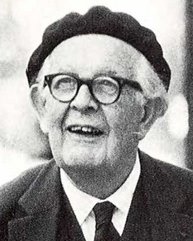
Photo: Unidentified (Ensian published by University of Michigan) / Wikimedia Commons (Public domain)

Jean Piaget

09-Aug-1896


Switzerland


Psychologist

Jean William Fritz Piaget (9 August 1896 โ€“ 16 September 1980) was a Swiss psychologist known for his work on child development. Piaget's theory of cognitive development and epistemological view are together called genetic epistemology. Piaget placed great importance on the education of children. As the Director of the International Bureau of Education, he declared in 1934 that "only education is capable of saving our societies from possible collapse, whether violent, or gradual". His theory of child development has been studied in pre-service education programs. Nowadays, educators and theorists working in the area of early childhood education persist in incorporating constructivist-based strategies. Piaget created the International Center for Genetic Epistemology in Geneva in 1955 while on the faculty of the University of Geneva, and directed the center until his death in 1980. The numbโ€ฆ Source: https://en.wikipedia.org/wiki/Jean_Piaget

QUOTES BY Jean Piaget


Every acquisition of accommodation becomes material for assimilation, but assimilation always resists new accommodations.

I am convinced that there is no sort of boundary between the living and the mental or between the biological and the psychological. From the moment an organism takes account of a previous experience and adapts to a new situation, that very much resembles psychology.

Education, for most people, means trying to lead the child to resemble the typical adult of his society... But for me, education means making creators... You have to make inventors, innovators, not conformists.

The essential functions of the mind consist in understanding and in inventing, in other words, in building up structures by structuring reality.

As far as the game of marbles is concerned, there is therefore no contradiction between the egocentric practice of games and the mystical respect entertained for rules. This respect is the mark of a mentality fashioned, not by free cooperation between equals, but by adult constraint.

If mutual respect does derive from unilateral respect, it does so by opposition.

The child who defines a lie as being a "naughty word" knows perfectly well that lying consists in not speaking the truth. He is not, therefore, mistaking one thing for another, he is simply identifying them one with another by what seems to us a quaint extension of the word "lie".

The child is a realist in every domain of thought, and it is therefore natural that in the moral sphere he should lay more stress on the external, tangible element than on the hidden motive.

VIEW MORE QUOTES BY Jean Piaget